
Searching Rush County Criminal Dockets
Start with Kansas CaseSearch, the free portal for Rush County District Court case information. Choose District for Court, Rush County for the county, and Criminal for case type. Got the full case number? Type it in and you are done. The form also lets you search by party name, business name where that applies, party as business name, or a full citation number. File-date filters can trim a long results list.
- Select District and Rush County in CaseSearch.
- Choose Case Number, Party Name, or Citation Number as appropriate.
- Add Criminal and a date range if the result set is broad.
- Open the correct result and read events in date order.
- Confirm the latest setting or request a public document through the clerk.
Rush County Criminal Search Fields
Matching the right Kansas court starts with the search fields. The portal shows full case numbers in a format like 2024-CR-000123. Copy the number straight from an official notice instead of guessing at one. A city citation may sit outside the Rush County District Court criminal docket, so it may not be a Rush County case at all.
| Field | Criminal use | Check |
|---|---|---|
| Court | District | Appellate only for an appeal |
| County | Rush County | Municipal tickets remain separate |
| Case Type | Criminal | Does not include every city ordinance case |
| Search Term | Full number, formatted name, or citation | Follow portal minimums |
| File Dates | Narrow by filing period | Clear if the correct case disappears |
The Smart Search guide also covers status, judicial officer, attorney, and cross-reference fields, plus identity fields that shift with your role. The live public display can change. Enter only the facts you need to pull up the case.
Inside a Rush County Criminal Docket
The Smart Search guide also covers status, judicial officer, attorney, cross-reference, and role-dependent identity fields. The live public display can change, and you only need to enter the facts that will actually locate the case.
| Charge or filing | Identifies a complaint, information, or other public charging event when available. |
|---|---|
| Appearance | Can identify a first appearance, arraignment, or related setting. |
| Motion and order | Separate events may show a request and the court's later action. |
| Hearing | May show date, time, type, judge, and location. |
| Disposition | May identify dismissal, diversion, plea, trial result, or another outcome. |
| Sentence and review | Can show judgment, sentencing, probation, costs, or later review events. |
A gap in the public court record proves nothing. Rule 22 redaction, a seal, the case type, your access role, and the 2022 eCourt conversion all shape what a Rush County docket shows.
Rush County Criminal Filing Snapshot
The official FY2025 criminal report covers the period ending June 30, 2025. It lists 8 felony filings and 30 misdemeanor filings in Rush County, for 38 total. The same report shows 10 pending felony cases. It also shows 21 pending misdemeanor cases at the cutoff. Remember, those are fiscal-year counts. They are not a live queue or a forecast of your next court date.
For comparison, FY2024 listed 22 felony and 27 misdemeanor filings, a total of 49. Annual totals can shift without telling you anything about one case. For that, read the Rush County criminal docket and its filed orders.
How a Criminal Case Moves
A Rush County criminal register typically opens with a filing or charging event. From there, an appearance and arraignment may follow. Motions, discovery filings, status settings, continuances, and orders tend to fill out the pretrial record. A plea or trial can then bring judgment, sentencing, probation review, closure, or appeal.
Filing → Arraignment → Pretrial → Plea or Trial → Disposition → Sentencing
Think of these labels as a map, not a fixed route. Rush County cases rarely march in lockstep. So the exact event words in the public record control over any summary label. Be careful with statistics tables, too. A row marked deferred or dismissed there cannot replace the case register. It cannot replace the signed order itself. One more wrinkle: an appeal can open a separate Kansas appellate record. The criminal docket you first find may not be the whole story.
Rush County Disposition Terms
The official FY2025 tables sort outcomes into broad buckets. For Rush County felonies, those buckets cover diversion or deferred adjudication, dismissals, guilty pleas, and other results, with no jury or court trial counted in that row. Misdemeanor totals rely on the same wide labels. Keep the limits in mind when you read them. These figures describe court reporting categories, not the full legal meaning of any single outcome on a criminal docket.
- Diversion or deferred adjudication
- A report category that must be read with the actual agreement, events, and orders.
- Dismissal
- An outcome ending a charge or case at that stage; it does not explain the reason by itself.
- Guilty plea
- A plea category that may be followed by judgment and sentencing events.
- Other
- A statistical category whose case-specific meaning requires the actual docket.
Never lean on one label alone. Put the event date, the charge or count, any related order, and the entries that follow side by side, because a bare label in the docket can stay incomplete until you read the public document behind it.
Courts That Hold Criminal Dockets
Where a Rush County criminal docket lives depends on the charge. The Clerk of the District Court in the 24th Judicial District maintains felony and misdemeanor state cases. City ordinance misdemeanors and ordinance traffic matters stay with the municipal court that issued them. Federal offenses are different altogether. They run through the U.S. District Court for the District of Kansas and its PACER or federal CM/ECF systems.
| Venue | Record | First route |
|---|---|---|
| Rush County District Court | State felony and misdemeanor cases | CaseSearch or district clerk |
| City municipal court | Municipal ordinance and city traffic matters | Citation and issuing city |
| Kansas appellate courts | Appealed state criminal cases | CaseSearch set to Appellate |
| District of Kansas | Federal criminal cases | PACER and CM/ECF |
McCracken's code includes a Municipal Court chapter, and La Crosse publishes an ordinance route of its own. None of the five profiled cities posts a live municipal case portal. For a city matter, calling the city office directly is the fallback that works.
Rush County Municipal Case Divide
La Crosse shows why venue matters so much. Its city ordinance page lays out the local code. But it will not show parties, events, settings, or a disposition in a live municipal case. A Rush County District Court search falls short the same way. It is not a full stand-in for the city docket. The La Crosse city site gives the municipal-office route for anyone who needs it.
With no live municipal portal posted, the city office is the practical contact for a La Crosse ordinance citation. For the law itself, the La Crosse ordinance page carries the legal text.
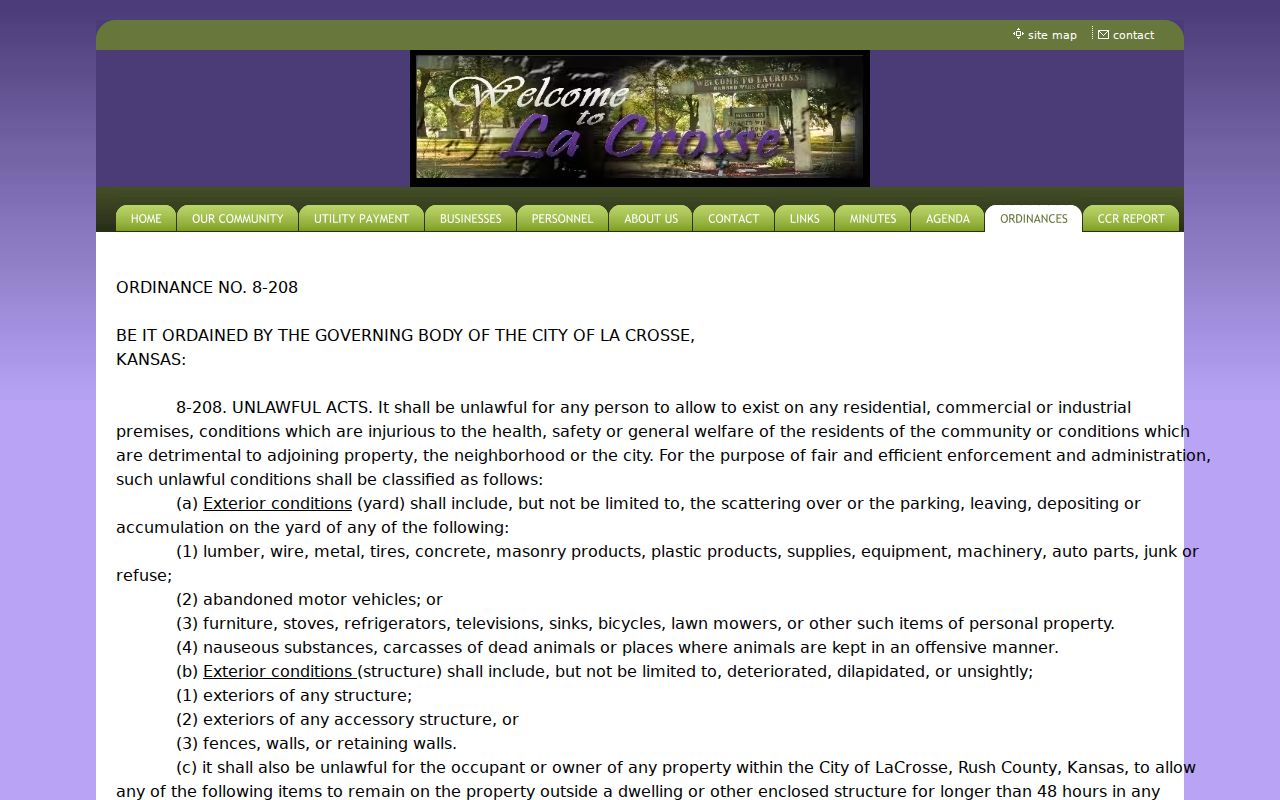
The ordinance text tells you which local rule applies. The citation and the municipal clerk, though, control the case date and any docket request.
Rush County Criminal Access Channels
CaseSearch leaves gaps. For the rest, go in person or reach Erin Werth, the Court Clerk, directly. The public terminal sits at 715 Elm Street in La Crosse. You can also phone 785-222-2718. Email works too: Erin.Werth@kscourts.gov, or mail Rush County District Court, P.O. Box 387, La Crosse, KS 67548. When you ask, confirm the item is public. Also ask whether a plain or certified copy is available.
- CaseSearch for basic public district case information.
- Courthouse terminal for public case data or records not shown online.
- District clerk for access, hearing, document, and copy questions.
- Written KORA court-record request for a specific public item.
- Issuing city for a municipal ordinance case.
The clerk publishes no Rush-specific fee schedule or counter hours. So check the copy price, certification cost, and delivery options before you send money or make the drive.
Sealed Dockets and Public Access
Two rules govern what the public can reach. Kansas Supreme Court Rule 22 sets the rules for portal and terminal access to public case records and lists the categories that stay out. Rule 24 guards personal identifiers from disclosure. Expect juvenile-related material, sealed filings, expunged matters, and other restricted documents to be missing or limited in any Rush County court docket search.
Access limit: A courthouse terminal may show public material that is not online, but sealed and nonpublic records are unavailable through both public outlets.
Read the results with care. A blank search does not mean no case exists. A visible case does not mean every document is open. Ask the Clerk of the District Court which lawful public route fits your situation. The clerk can route a request. She cannot break a seal, though, or release material barred by rule, statute, or court order.